

Close views of Paul Richards during an Extravehicular Activity (EVA) on the International Space Station (ISS). View STS102-346-021 is a crew pick selection.
The NASA Goddard Space Flight Center posted a set of images on Flickr entitled ‘Gravity’ – NASA’s Real-Life Images from Space in reference to the award-winning film ‘Gravity.’
These photos are absolutely breathtaking. The mysteries of space has always fascinated me. Check out NASA Goddard Space Flight Center Flickr page to see more amazing photos.

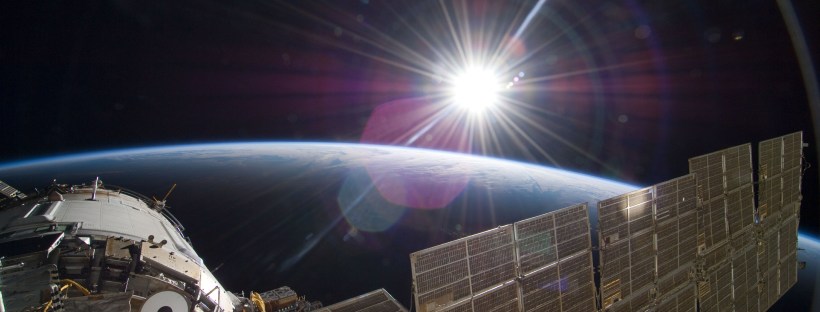
Sun Over Earth (NASA, International Space Station Science, 11:22:09)
The bright sun greets the International Space Station in this Nov. 22 scene from the Russian section of the orbital outpost, photographed by one of the STS-129 crew members. Image credit: NASA

The Ulitimage Photo Shoot Location – Targeting Earth Photographs From Orbit
Inside the Cupola, NASA astronaut Chris Cassidy, an Expedition 36 flight engineer, uses a 400mm lens on a digital still camera to photograph a target of opportunity on Earth some 250 miles below him and the International Space Station. Cassidy has been aboard the orbital outpost since late March and will continue his stay into September.
Image Credit: NASA

The city lights of Spain and Portugal define the Iberian Peninsula in this photograph from the International Space Station (ISS). Several large metropolitan areas are visible, marked by their relatively large and brightly lit areas, including the capital cities of Madrid, Spain—located near the center of the peninsula’s interior—and Lisbon, Portugal—located along the southwestern coastline. The ancient city of Seville, visible to the north of the Strait of Gibraltar, is one of the largest cities in Spain. The astronaut view is looking toward the east, and is part of a time-lapse series of images. Credit: NASA Earth Observatory

Mission Specialist Bruce McCandless II, is seen further away from the confines and safety of his ship than any previous astronaut has ever been. This space first was made possible by the Manned Manuevering Unit or MMU, a nitrogen jet propelled backpack. After a series of test maneuvers inside and above Challenger’s payload bay, McCandless went “free-flying” to a distance of 320 feet away from the Orbiter. This stunning orbital panorama view shows McCandless out there amongst the black and blue of Earth and space. – Credit: NASA

Soyuz Spacecraft docked to the ISS during Joint Operations
View of Soyuz Spacecraft docked to the International Space Station (ISS). Earth limb is visible in the background. Photo was taken during STS-127 / Expedition 20 Joint Operations. NASA Identifier: s127e008664

Astronaut Sunita L. Williams, Expedition 14 flight engineer, used a pistol grip tool as she worked on the International Space Station in the first of three spacewalks slated to occur over a nine-day period. During the 7-hour 55-minute spacewalk that took place on Jan. 31, 2007, Williams and station commander Michael E. Lopez-Alegria (out of frame) reconfigured one of two cooling loops for the Destiny laboratory module, rearranged electrical connections and secured the starboard radiator of the P6 truss after retraction. – Image credit: NASA

Space Station on May 29, 2011
S134-E-010590 (29 May 2011) — Backdropped by Earth’s horizon and the blackness of space, the International Space Station is featured in this image photographed by an STS-134 crew member on the space shuttle Endeavour after the station and shuttle began their post-undocking relative separation. Undocking of the two spacecraft occurred at 11:55 p.m. (EDT) on May 29, 2011. Endeavour spent 11 days, 17 hours and 41 minutes attached to the orbiting laboratory. ..Photo credit: NASA
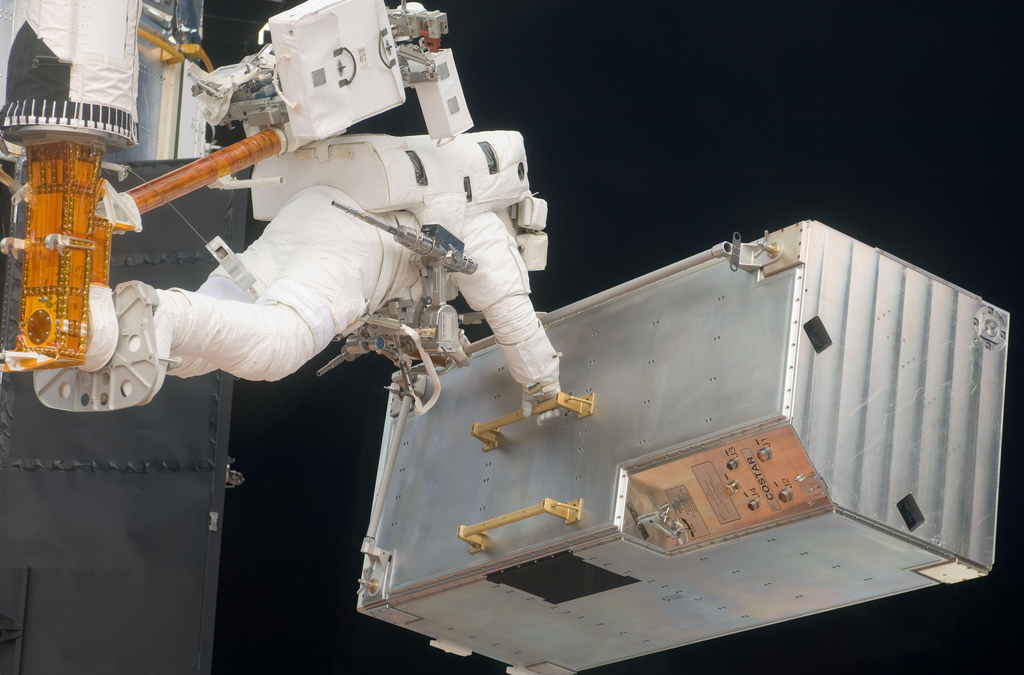
Working on COSTAR
STS-125 Mission Specialist Andrew Feustel positioned on a foot restraint on the end of Atlantis’ remote manipulator system moves the Corrective Optics Space Telescope Axial Replacement (COSTAR) during the mission’s third session of extravehicular activity (EVA) as work continues to refurbish and upgrade the Hubble Space Telescope. Photo credit: NASA – May 16, 2009

Storm Clouds Over the Atlantic Ocean Near Brazil
One of the Expedition 36 crew members aboard the International Space Station used a 50mm lens to record this image of a large mass of storm clouds over the Atlantic Ocean near Brazil and the Equator on July 4, 2013. A Russian spacecraft, docked to the orbiting outpost, partially covers a small patch of sunglint on the ocean waters in a break in the clouds. – Image Credit: NASA

A close-up of Astronaut John Grunsfeld shows the reflection of Astronaut Andrew Feustel, perched on the robotic arm and taking the photo. The pair teamed together on three of the five spacewalks during Servicing Mission 4 in May 2009.

ISS007-E-14883 — This close-up view of the eye of Hurricane Isabel was taken by one of the Expedition 7 crewmembers onboard the International Space Station (ISS).
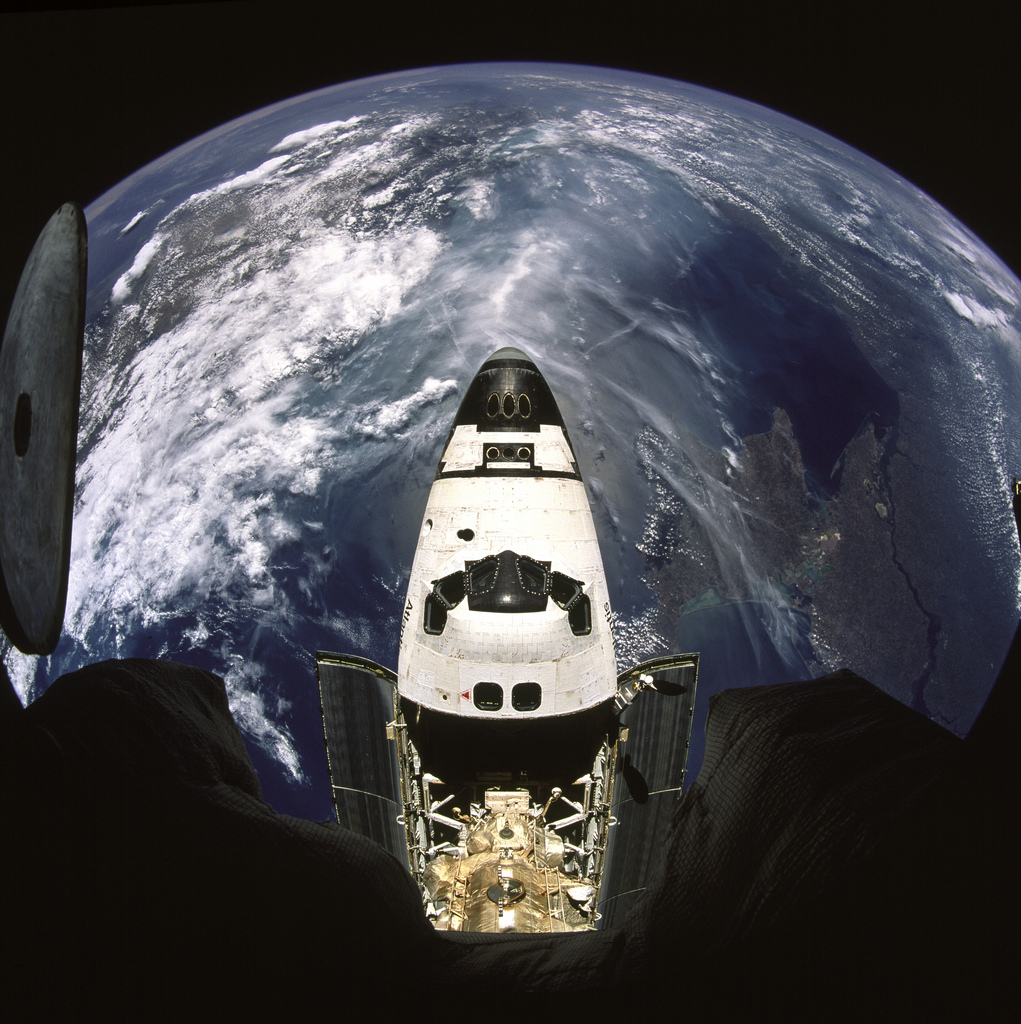
Beautiful Earth and NASA’s Space Shuttle Atlantis (STS-71), July 2, 1995 at 11:40:12 GMT
As Seen From the Russian Federation Mir Space Station
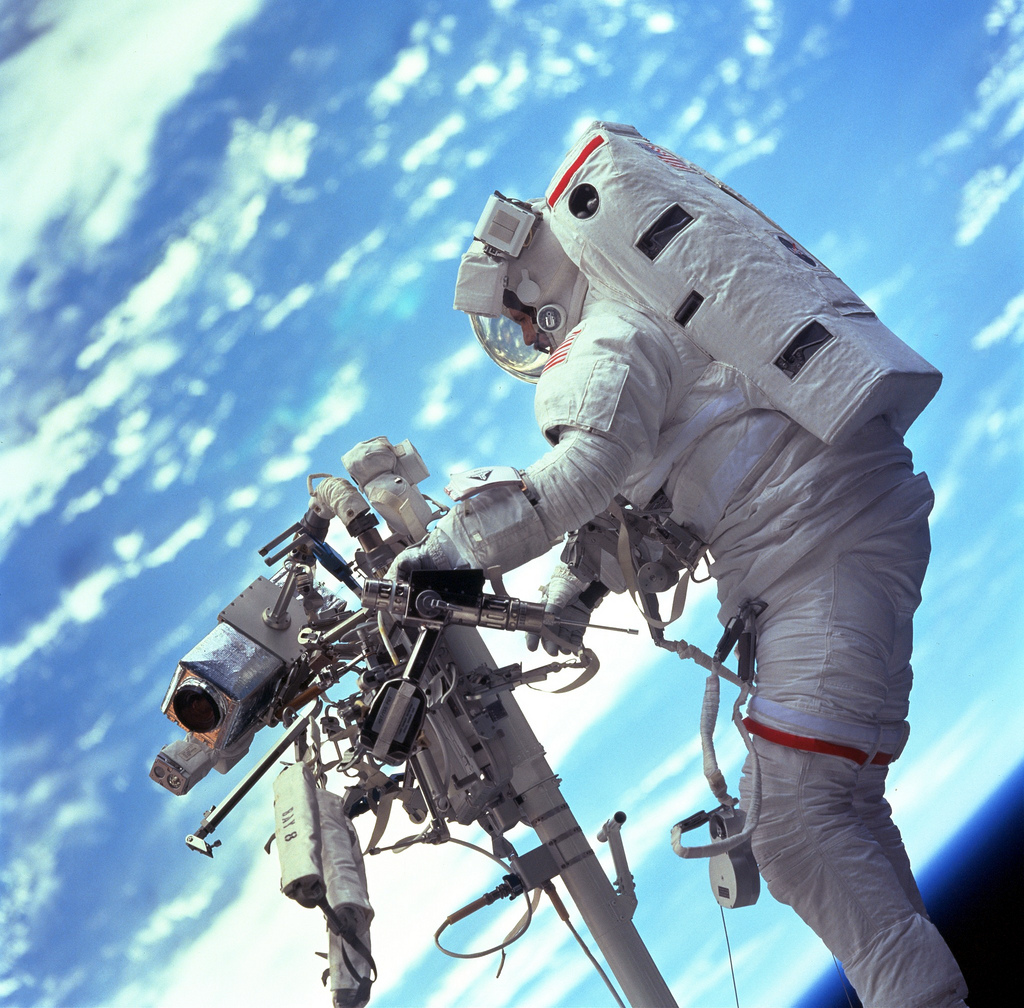
STS103-701-047 (19-27 December 1999) — Astronaut Steven L. Smith, payload commander, retrieves a power tool while standing on the mobile foot restraint at the end of the remote manipulator system (RMS). Many of the tools required to service the Hubble Space Telescope are stored on the handrail attached to the RMS visible in the photograph.
Credit: NASA
[Via NASA Goddard Flickr stream]

 We Geek Girls
I am in awe…those are absolutely beautiful photos. great post. 🙂
LikeLike
Thanks! They have some beautiful photos on their Flickr page. It was hard narrowing a few down. 🙂
LikeLike